
Service · Concrete
Concrete Driveways, Slabs & Flatwork
Poured-in-place concrete driveways, sidewalks, aprons, patios and structural slabs across Lake County and Northeast Ohio.
Concrete is the workhorse of residential and commercial flatwork. Done right, a concrete driveway or slab will outlast the mortgage on the house. Done wrong, it cracks, spalls, heaves in the first winter, and becomes a very expensive lesson. The difference is in the details: subgrade preparation, correct mix design for Ohio's climate, proper reinforcement, well-placed control joints, and finishing at the right moment as the slab sets.
Rendon Paving pours concrete for homes and businesses throughout Painesville, Willoughby, Eastlake, Concord Township, Kirtland, Wickliffe, Chardon, Chesterland, Mayfield Heights, Shaker Heights, Cleveland Heights and the Cleveland Metropolitan Area. We use air-entrained ready-mix concrete rated for freeze-thaw durability, reinforce every slab with rebar or welded wire, and finish with the technique that fits the application, whether that's a broom finish for grip, a smooth trowel finish for a garage floor, or an exposed aggregate look for a patio.
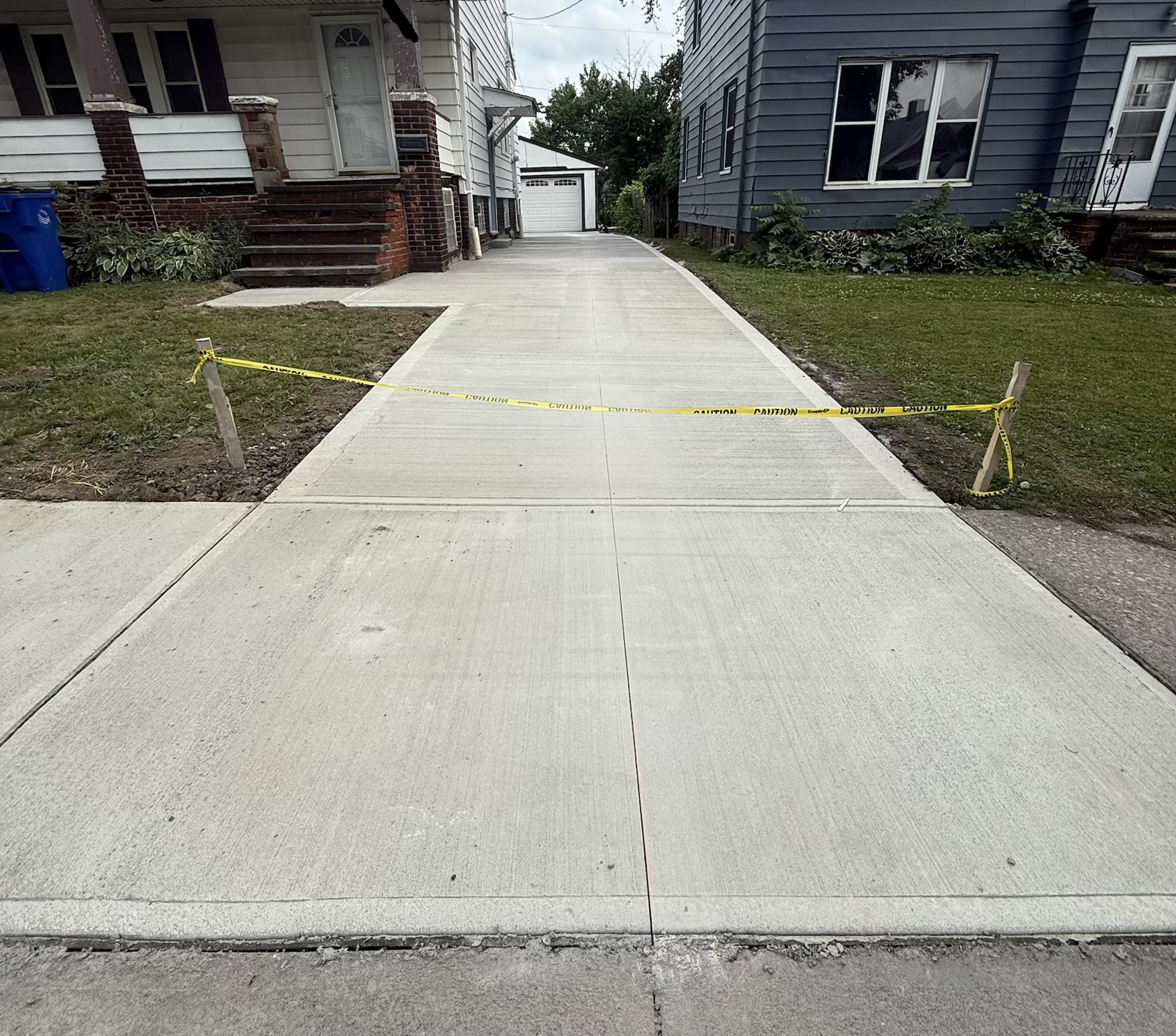
Our Concrete Installation Process
Concrete work is unforgiving because you can't fix mistakes after the pour. Our process is built to catch issues before the ready-mix truck arrives.
1. Layout and forming. After tear-out and excavation, we set forms to the finished grade, checking slope carefully. Driveways need a minimum of 1/4 inch per foot of pitch away from the house for drainage.
2. Base preparation. A 4 to 6 inch layer of compacted #57 or #304 stone is placed under the slab. This gives the concrete uniform support and a place for water to escape below the surface.
3. Reinforcement. Rebar on chairs or welded wire mesh is placed at the mid-depth of the slab. This holds the concrete together after inevitable hairline shrinkage cracks form.
4. Pouring and screeding. Ready-mix concrete is placed, screeded to grade, and bull floated to knock down aggregate and bring paste to the surface. Timing here is critical, especially in hot or windy weather.
5. Finishing and jointing. Once the slab has firmed up we broom finish for traction, edge the perimeter, and tool or saw cut control joints. Every slab is finished with the specific look you asked for.
6. Curing. We apply a curing compound or cover the slab to lock in moisture. This step is often skipped by cheaper crews and it's a big reason surface concrete fails prematurely.
Concrete Services We Offer
- Residential concrete driveways and driveway aprons
- Sidewalks and walkways to code
- Patios, including exposed aggregate and stamped finishes
- Garage floors and shed pads
- Steps, stoops and porches
- Concrete slabs for hot tubs, generators, dumpsters and equipment
- Curb and gutter work for commercial and municipal projects
- Concrete replacement and section cutout repair
How Ohio Weather Affects Concrete
Northeast Ohio's freeze-thaw cycles are especially hard on concrete. Water gets into pores, freezes, expands and pops the surface off in flakes. That's called spalling, and it's almost always caused by one of three things: the wrong mix, missing air entrainment, or road salt applied in the first winter after installation.
We spec 4,000 psi air-entrained ready-mix for all exterior flatwork, which builds in microscopic air bubbles that give freezing water room to expand without damaging the concrete. We also strongly recommend that homeowners avoid deicing salt (especially calcium chloride and magnesium chloride) for the first full winter after a pour, and use plain sand for traction instead.
Benefits
- 30 to 40 year lifespan with minimal maintenance
- Brighter, more reflective look than asphalt
- Higher property value and stronger curb appeal
- Handles heavier vehicles and equipment without deforming
- Doesn't soften in extreme summer heat
- Wide range of finish options: broom, trowel, exposed aggregate, stamped
Materials & Equipment
- 4,000 psi air-entrained ready-mix concrete
- #4 rebar or 6x6 welded wire mesh reinforcement
- #57 or #304 compacted stone base
- Expansion joint filler where slab meets structures
- Cure and seal compound to control initial moisture loss
- Vapor barrier under interior slabs when required
Why Choose Rendon Paving
Every pour is supervised by an experienced finisher, no leaving new crew members alone with wet concrete.
We build a proper stone base and reinforce every slab. Both cost more up front and save you money over 30 years.
Air-entrained mix is standard on our jobs, not an upcharge.
Straight, evenly spaced control joints so cracks stay hidden.
1 year workmanship warranty and clear guidance on curing and sealing.
Licensed and insured Ohio contractor with 5.0 star Google and Yelp reviews.
Frequently Asked Questions
How long does concrete take to cure before I can drive on it?+
Foot traffic is fine after 24 to 48 hours. Passenger vehicles should stay off for 7 days. Heavy vehicles, trailers, dumpsters and moving trucks need a full 28 days for concrete to reach its designed strength. We tape off freshly poured slabs so no one drives on them by accident.
How thick should a concrete driveway be?+
For standard passenger vehicles we pour 4 inches of concrete over a compacted stone base. If you park RVs, trailers, or trucks over 10,000 pounds we bump that up to 5 or 6 inches with additional rebar or wire mesh. Sidewalks and patios are typically 4 inches; commercial slabs are engineered case by case.
Do you install control joints and why do they matter?+
Yes. We tool or saw cut control joints every 8 to 12 feet on driveways and slabs. Concrete shrinks as it cures, and cracks are inevitable, control joints tell the concrete where to crack so it happens along a clean, straight line instead of randomly across the surface.
Should I choose concrete or asphalt for my driveway?+
Concrete lasts longer (30 to 40 years vs. 20 to 30 for asphalt), has a brighter look, and requires less maintenance. Asphalt is less expensive upfront, more forgiving in cold climates, and easier to repair. We install both, so we'll give you a straight recommendation based on your budget, soil and how you use the driveway.
Can concrete be poured in cold or hot weather?+
Yes, with the right precautions. In cold weather we use accelerators, insulating blankets, and schedule pours for the warmest part of the day. In hot weather we pour early morning and use retarders. We avoid pouring below 40°F rising and above 90°F when possible.
Do you seal new concrete?+
We recommend sealing concrete driveways and patios 30 days after installation, then every 2 to 3 years. Sealer protects against road salt, oil stains and freeze-thaw damage. We can apply the initial coat as part of your project or leave it for you.
Related Services
Free Estimates · 1 Year Warranty